

Raise Wages, Starve Clinics: The Quiet Crisis Behind Fair Work Reforms
Update · 14 August 2026
This article was published in April 2025, while the Fair Work Commission’s gender-based undervaluation review of the Health Professionals and Support Services Award (MA000027) was still being argued. It is kept here as written.
The review has since been decided. In the proceedings this article describes, the Fair Work Commission set the new classification structure and minimum rates in its decision of 24 December 2025, [2025] FWCFB 297, and made the final determination on 26 May 2026, [2026] FWCFB 123. The new health professional classification structure commences on 1 October 2026 — the October 2026 reclassification — and the increases phase in across five stages to 30 June 2030. The Fair Work Ombudsman’s summary of the changes sets out the same sequence in plain English.
For the current position, see the Health Professionals Award (MA000027) hub and the 2026 award changes field guide.
The Fair Work Commission’s (FWC) latest move on the gender pay gap has been lauded by the media and politicians alike.
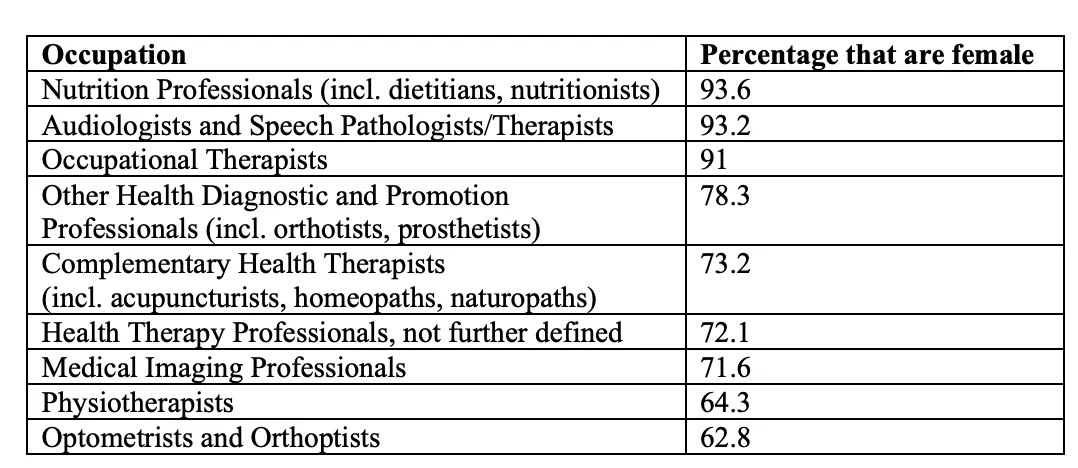
At first glance, it’s the kind of progress that deserves applause: addressing the deeply embedded wage inequities across highly feminised industries like physiotherapy and allied health.
But let’s not be fooled by polished headlines and election-year theatrics.
Beneath the surface, these wage reforms expose a harsh reality: government policy continues to undermine business owners while pretending to champion equality.
The Gender Problem Health Can’t Shake
The health and support sectors — highly skilled, profoundly human industries — have long been powered by women.
Not just at the frontline but in business ownership too.
Many of these women have built clinics from scratch, driven by resilience, compassion, and expertise.
They deserve recognition.
Yet the structure they've been forced to operate in has historically punished them.
From contracting agreements prior to 2009, to mediocre awards owing to, in the words of former FWC vice president, Graeme Watson - "historical inertia".
To now, in 2025 with Systemic Shortcomings within NDIS rates and a health economy in need of Medicare Reform.
Let's not forget extortionate commercial rent to go with burdensome compliance costs.
And now, sweeping wage reforms that threaten the survival of their businesses altogether.
Raising Wages — Without Raising Revenue
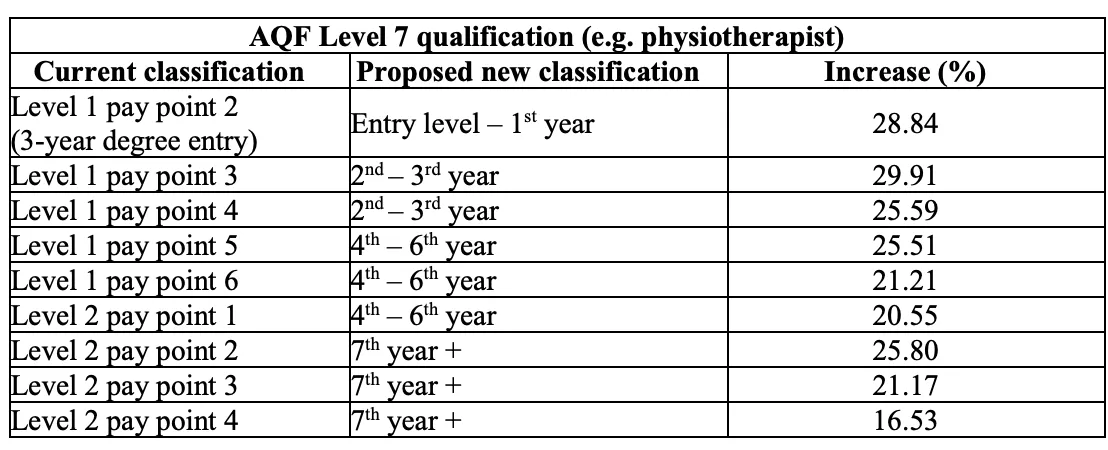
Under the proposed FWC changes, a new graduate physiotherapist's base pay would jump almost 30%, pushing annual salaries close to $90,000 including super.
Sounds progressive, right?
It would be — if the commonwealth funding that underpins the health sector had moved an inch in the past six years.
It hasn’t.
NDIS, DVA, Medicare — the very billing structures that private clinics rely on — have remained stagnant.
No new inflows.
Minimal adjustments for inflation, none in the NDIS case.
No recognition for the complex, skilled work allied health professionals deliver daily.
So what does this mean for practice owners?
Costs rise, but revenue stays flat.
Without dramatic shifts in pricing models or service delivery, many clinics face an impossible squeeze.
The starting rate is only the first year of it. Set the hire year, the hours and your own wage-review assumption to see what the same graduate costs as they move through the bands.
Hourly rate
Per week
Per year (base)
Two things lift the cost at once
These rates apply from 1 October 2026. Before that, the old pay-point structure is in force.
As the grad gains experience they move up the bands — 1st year, then 2nd–3rd, then 4th–6th, then 7th year and beyond. At the same time, the new award rates phase in from 1 October 2026 to 30 June 2030. The person climbs and the rates climb, so the cost rises faster than either on its own.
The jumps are the band crossings
Most years are a steady single-digit rise. The big steps land when they cross a band — around year 4 (into 4th–6th) and year 7 (into 7th year+). A grad is not a fixed cost. They are an escalating one, and the steps are the part owners do not see coming.
What is locked, and what is your call
Two of the five stages are settled rather than proposed. The 1 October 2026 rate comes from the determination the Commission has already made, and the 30 June 2030 rate is its published end point; both are in today's dollars, with the confirmed 4.75% review applied and your own assumption compounding on top. The three steps in between — 2027, 2028 and 2029 — follow the Commission's own staging method, which is equal annual increments with a minimum 3% increase at each of the middle stages and the balance paid at the last. Those three figures appear in a draft determination issued on 14 August 2026 and have not been finalised yet, so read them as the Commission's stated intention rather than as settled rates. Everything past 4.75% is your inflation assumption — drag the slider. The first step lands on 1 October 2026; the four after it land on 30 June, so from 2027 onward the back half of a year runs one step higher than the front half. Figures are base wage plus 12% super; leave loading, penalties and bonus sit on top.
About this calculator
These figures model a new graduate starting on the first-year rate. Don't use them to set pay for someone who was already on your team before 1 October 2026 — they keep their old rate as a floor where it's higher, and this calculator doesn't check that.
Follow the Money not the Fair Work Commission
Curiously, while female dominated allied health practices are left to suffocate under funding freezes, other sectors receive an injection of cash.
General Practice — a 50:50 male-to-female sector — has seen Medicare subsidies lifted just in time for the election.
Meanwhile, Canberra GP clinics score million-dollar bailouts to keep the lights on.
You don’t need a PhD in economics to spot the pattern: funding flows where traditional ownership structures are strongest.
It’s a damning contradiction for a government positioning itself as a champion of gender equity.
The Third Door: Structural Inequality at Work
The sad irony?
By pushing up wages without lifting the pricing floor, the reforms the government touts as ‘fair’ could result in more female-led businesses shutting their doors.
- Raise wages ✅
- Cut NDIS funding ❌
- Refuse to update Medicare or NDIS rates ❌
It’s a shell game. One that’s already hurting the very entrepreneurs it pretends to uplift.
If groceries now cost more than a Medicare-funded EPC consult, how can clinics be expected to survive — let alone thrive?
The answer is simple: they can’t under the current model.
Where to Next for Ethical Clinic Owners?
At Culture of One, we believe in resilience.
We believe in individuality.
And we believe that innovation, not blind compliance, is the future.
That’s why we’ve been preparing our community for these seismic changes for over two years.
If you're a practice owner reading this, now is the time to:
- Focus on building a direct-to-patient (cash-paying) ecosystem.
- Restructure contracts to reflect a fair but sustainable wage framework.
- Price your services independently of government handouts.
We’ve mapped a path forward inside our Circle Platform and via our private coaching programs, including our industry leading Profits course.
Don't wait for politicians or bureaucrats to value your work.
Related reading
- The 2026 Health Professionals Award changes: what they actually cost your clinic — the field guide to what actually changed, and what it costs.
- Clinic owners: your second pay rise hits October 1 — what to line up before the October 2026 reclassification.
- How exposed is your clinic to the 2026 award changes? — which clinics the increase hits hardest, and how to measure your own.
- Admin and receptionist award rates: MA000027 Support Services — the award’s other stream. The October 2026 reclassification does not reach reception or admin staff.
- New graduate physio salaries in Australia — the graduate salary argument this piece set off, with a calculator for what a first-year costs.
- New financial year prices — setting prices for a new financial year so the increase does not land straight on the margin.
The course
REBUILD — the October reclassification, start to finish
Nine short segments and nine worksheets: translating every clinician into the new structure, running the higher-of-two-rates comparison one person at a time, and knowing each person’s lawful minimum from 1 October 2026. Self-paced, one payment, yours to keep.
The answers on this page are free. REBUILD is the implementation.
About this information
Culture of One is a business advisory firm, not a law firm. This is general information about the Health Professionals and Support Services Award — not legal or workplace-relations advice — and it doesn't take account of your clinic, your contracts, or any individual's circumstances. Forward dollar figures are estimates, not final rates. The FY2027–FY2029 steps come from a draft determination the Fair Work Commission issued on 14 August 2026 and have not been finalised. The 1 October 2026 and 30 June 2030 rates are settled, but every figure is in today's dollars and rises again each year as the annual wage review is applied on top. Before you change anyone's classification or pay, get advice on your own situation.
Current as at 18 August 2026.


Recent Insight Articles
Explore more expert insights to deepen your understanding and find practical solutions for advancing your clinic's growth and sustainability.